Since we started this course in January, I have learned so much about journalism and the history of news in our country. We started off the course with a refresher on the First Amendment and Constitution, looking at some of the things we studied in media law and ethics/literacy.

I needed to be reminded of this because sometimes it is hard for me to be critical in my work as a journalist. I always want to share the good news, and at times I dread sharing bad news, particularly when it is something I am personally criticizing. In general, you could say that I struggle with opinion pieces that are more negative than positive, but I am working on this in our opinion writing course. I need to remember the importance of being critical when it is necessary, especially when it comes to the government.

Something that I found incredibly interesting in media law and ethics/literacy was the State Action Doctrine, and I am glad I was also able to be refreshed on it in this class. The State Action Doctrine reads, "Without government involvement no constitutional claim can be made because only the government can violate your constitutional rights: Therefore, the first amendment doesn’t reach private actors." This is why people can still sue for libel, or defamation.
Along with the "watchdog" role and State Action Doctrine, we also learned about the Twitter Files. In this case, accusations were made that the government was involved in the censorship. Journalists defended the government and tried to cancel fellow journalists for reporting on the truth. Those journalists were trying to play the watchdog role. Matt Taibbi and Bari Weiss, two American journalists, showed thousands of emails from social media companies that have direct conversations with the government. This was a really fascinating example of the principles we have learned about in class being seen in real life.
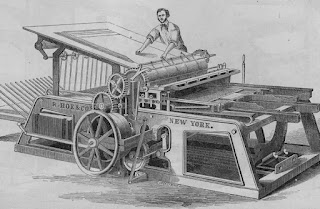 |
| The Printing Press |
Colonial Press: Learning about this era, I saw how important the press was in working towards America's independence. In 1729, Benjamin Franklin started his own paper to vaguely hint at independence. On the opposite side of things, there were also incidents where the government tried to halt independence. In 1722 James Franklin was put in jail for using a confidential source who criticized the government. In good news for the press, in 1769, Isaac Doelittle made a major advancement for the press by creating the mechanical press, allowing multiple pages to be printed quickly.

Partisan Press: By this time, America had just declared its independence. In 1776, Thomas Paine created an editorial style pamphlet called "Common Sense" in which he criticized the government. In 1789, James Madison wrote the First Amendment, a major step towards protecting the press. However, in 1798, the Sedition Act went into effect and made it a crime to criticize the government. Luckily in 1800 after the Jefferson vs. Adams election, Jefferson got ride of the act. In 1823, Jones Booth created the steam-powered press making printing even faster.
Penny Press: This era begins in the 1800s. In 1833, Benjamin Day of the New York Sun makes newspapers more affordable and available to the public by only charging one cent but printing more papers. In 1844, Samuel B. Morse invented the telegraph allowing information to be spread quicker and across larger distances. In 1852, Charles Dana of the New York Times began the "objectivity standard" by reporting both sides. This was the opposite of the Partisan Era. In 1861, the Civil War began, and it was a time of censorship.
These are just some of the key facts from these timelines. The timelines really allowed be to gain a better understanding of journalism history and how it effected journalism in our modern world.
This post includes just a small portion of what we have learned in class, and I am excited to learn more and grow in my knowledge of journalism history.


.webp)